Blood Spot in an Egg: What It Means and Is It Safe to Eat?
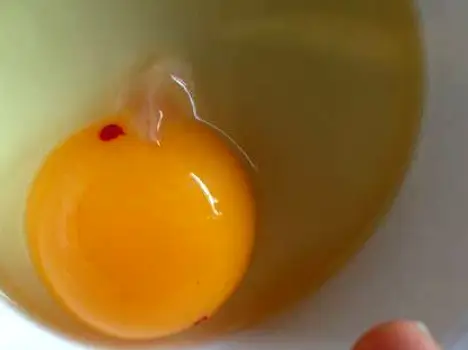 h2>What a blood spot in an egg means
A blood spot is a small inclusion of blood that formed while the egg was developing inside the hen. You may notice it on the yolk after cracking the egg. The red material is not a developing chick, and its presence does not tell you whether the egg was fertilized.
An isolated blood spot does not automatically mean the egg must be discarded. Its significance for food safety depends on the condition of the rest of the egg, not on the spot alone.
Why blood spots form in the yolk or white
An egg yolk develops in the hen's ovary, then enters the oviduct, where the rest of the egg is assembled. A small blood vessel can break as the yolk is released, leaving blood on its surface.
A spot found in the white, away from the yolk, may instead have arisen in the oviduct later in egg formation. Location helps explain how an inclusion could form, but it is not a definitive way to identify its origin. One spotted egg also does not establish that the hen is ill or has a particular nutritional deficiency.
Understanding blood spots in eggs
Blood spots, meat spots, and other egg changes
A blood spot is a localized red inclusion. A meat spot may consist of tissue or cellular debris and is commonly found in the white. Small inclusions can be difficult to identify precisely by appearance alone; not every reddish or brown speck signals spoilage.
The appearance of the white itself provides a different kind of clue. Cloudy raw egg white is not a spoilage sign by itself: it can reflect carbon dioxide that has not yet escaped through the shell and can indicate a very fresh egg. Pink or iridescent white, by contrast, is a spoilage sign according to the USDA. A tiny, distinct spot should not be confused with a widespread change in the egg's contents.
Is an egg with a blood spot safe to eat?
Yes. A small blood spot alone does not make an otherwise acceptable egg unsafe or reduce its nutritional value. The spot is not, however, a test for other food-safety hazards. The FDA notes that even fresh eggs with clean, uncracked shells can contain Salmonella.
Follow ordinary egg-cooking precautions regardless of whether you see a spot. FDA guidance recommends cooking eggs until both the yolk and white are firm and cooking dishes containing eggs to 160°F. For recipes served raw or undercooked, it recommends pasteurized shell eggs or pasteurized egg products.
Food safety and religious practice are separate questions. OU Kosher advises discarding an egg with an actual blood spot in ordinary circumstances under its published guidance. Readers seeking a ruling for their own practice can consult their religious authority; that guidance does not mean the spot itself is a food-safety hazard.
What to do after finding a blood spot
- Look at the rest of the cracked egg. If the spot is small and isolated and the egg otherwise appears acceptable, you can leave it in or remove it with the tip of a knife for preference. Removing the spot does not remove any Salmonella that might be present elsewhere in the egg.
- Discard the egg if it has an off odor or an unusual appearance, including pink or iridescent white. Do not treat broadly abnormal contents as though they were simply a small blood spot.
- If using the egg, handle and cook it as you normally would for egg safety. Keep eggs refrigerated at 40°F or below, and wash hands, utensils, equipment, and work surfaces with hot, soapy water before and after contact with raw eggs.
An egg that looks and smells normal is not guaranteed to be free of Salmonella. That is why the same handling and cooking precautions apply whether a blood spot is visible or not.

Why some eggs have more spots than others
How often blood spots form and how often shoppers find them are different questions. Poultry-extension guidance identifies genetics, hen age, stress, activity, and vitamin balance as factors that can affect spot frequency. These are general factors, not a way to diagnose the cause of a spot in any particular egg.
Brown-egg layers tend to have a higher incidence of spots than white-egg layers. Spots can also be harder to see through brown shells during candling, the screening process used to identify internal blemishes in commercial eggs. Candling does not catch every spot, so an egg with a small inclusion can still reach a store shelf.

Eggs that do not go through commercial candling may likewise reach the person cracking them without that screening step. Neither finding a spot nor having a brown-shell egg means the egg is unsafe.
A small blood spot on an egg yolk or white is simply a fragment of blood that was released during egg formation and does not indicate a fertilized egg, illness, or nutritional deficiency in the hen. The presence of a blood spot alone does not make the egg unsafe and does not reduce its nutritional value; it is not a marker for Salmonella or other food-safety hazards. Standard egg-handling precautions remain necessary, including refrigeration at 40 °F (4 °C) or below and cooking to a firm yolk and white or to 160 °F (71 °C) for any dish that contains eggs.
An egg that smells foul or has a pink or iridescent white is a spoilage sign and should be discarded, whereas a single isolated spot on an otherwise normal egg can be left in or removed for personal preference.
Blood spots occur more often in eggs from certain genetics, hen age, stress, activity, and vitamin balance, and brown-shell eggs tend to show spots more frequently than white-shell eggs, but spotting does not make an egg unsafe.
Publishing organization: USDA Food Safety and Inspection Service
Questions and comments
Please do not include passwords, medical record numbers, insurance information, financial information, precise addresses, or other confidential or directly identifying information in your message.